
TNUoS (Transmission Network Use of System) charges apply to all electricity consumers in Britain to cover the costs of operating and expanding the national grid.
This guide explains how they work, who sets and collects these fees, how their different components are calculated, how they appear on electricity bills, and how to reduce them.
What are TNUoS charges?
TNUoS (Transmission Network Use of System) charges are fees paid by electricity customers to cover the cost of operating, maintaining and developing Britain’s high-voltage transmission network, known as the national grid.
This is the network responsible for delivering electricity from power generators distributed across Britain, often far away from densely populated or industrial areas, on to consumers.
TNUoS charges are part of a trio of charges that fund Great Britain’s power infrastructure, working in parallel with:
- DUoS charges: Funds the operations, maintenance and development of the lower voltage, regional distribution networks.
- BSUoS charges: Funds the active service of balancing supply and demand on the grid.
TNUoS charges are a fixed amount that is independent of the customer’s consumption. The amount depends on the site’s location, along with supply characteristics such as meter type, voltage, and agreed capacity.
It typically makes up around 5–20% of domestic and business electricity prices, though this share varies significantly by customer type and location, and is rising as network investment increases.
Who sets and collects TNUoS charges?
Various public and private entities are involved in setting and collecting the TNUoS charges levied on consumers of electricity from the grid.
Here is how it works:
Who sets TNUoS charges?
TNUoS charges are set by the National Energy System Operator (NESO), the government-owned overseer of the national grid.
NESO does this on behalf of the three independent companies that own and operate the national grid infrastructure:
- National Grid Plc: Operates the transmission infrastructure in England and Wales.
- Scottish & Southern Electricity Networks: Operates the transmission infrastructure in Northern Scotland.
- Scottish Power Energy Networks: Operates the transmission infrastructure in Southern Scotland.
While NESO determines the charge, Ofgem, the UK’s energy regulator, sets a ceiling through its price control process.
This caps the revenue transmission operators are permitted to recover from consumers over a set period, based on the investment required to maintain and expand the grid.
Who collects TNUoS charges?
TNUoS are collected from consumers through suppliers, who aggregate it to pay NESO, who then distribute it to grid operators:
- Electricity consumers pay TNUoS charges to domestic and business energy suppliers through their electricity bills.
- These suppliers then pay the aggregate collected from all customers to NESO.
- NESO then distributes the funds to the three operators.
How are TNUoS charges calculated for businesses?
NESO carries out a four-step process each year to determine the actual TNUoS tariffs that the different types of electricity consumers pay.
1. Setting the overall revenue target
Each year, NESO calculates how much the three transmission operators will require to cover their planned capital projects, day-to-day operations and maintenance work for the year ahead, up to the ceiling Ofgem has approved.
This figure becomes the overall revenue target that TNUoS charges are designed to raise.
There is a location-dependent charge based on where a site is located on the network, and a residual charge, depending on the site’s power supply properties.
2. Working out the location-dependent charge
TNUoS charges incorporate a locational component because the cost of transmitting electricity from generator to consumer varies depending on where the site sits within the national grid.
NESO runs complex models of how the transmission system would behave across the country to estimate the cost impact of drawing power from the 27 generation zones, and feeding it into each of Britain’s 14 demand zones.
These modelled costs form the basis for the zonal rates applied to different regions.
3. Calculating the residual charge
NESO also works out a residual (non-locational) charge that depends on the site’s electricity supply characteristics, including its meter type, supply voltage, agreed capacity and whether the customer is domestic or non-domestic.
This residual element takes into account forecasts of demand and available generation capacity across the country, and is calibrated so that, combined with the zonal charges, the total amount collected matches the total revenue target.
4. Publishing the tariffs
Draft tariffs are typically published in November, ahead of the new charging year starting the following April.
These figures are then refined over the following weeks, with final tariffs confirmed and published in January on the NESO website.
How do TNUoS demand zones work?
Demand zones determine the location component of TNUoS charges, reflecting the cost that a site’s location imposes on the transmission network.
There are 14 demand zones in Britain, each corresponding to a DNO (Distribution Network Operator) region. These are regional low-voltage power distribution networks that connect to the national grid, and deliver power to individual homes and businesses in their area.
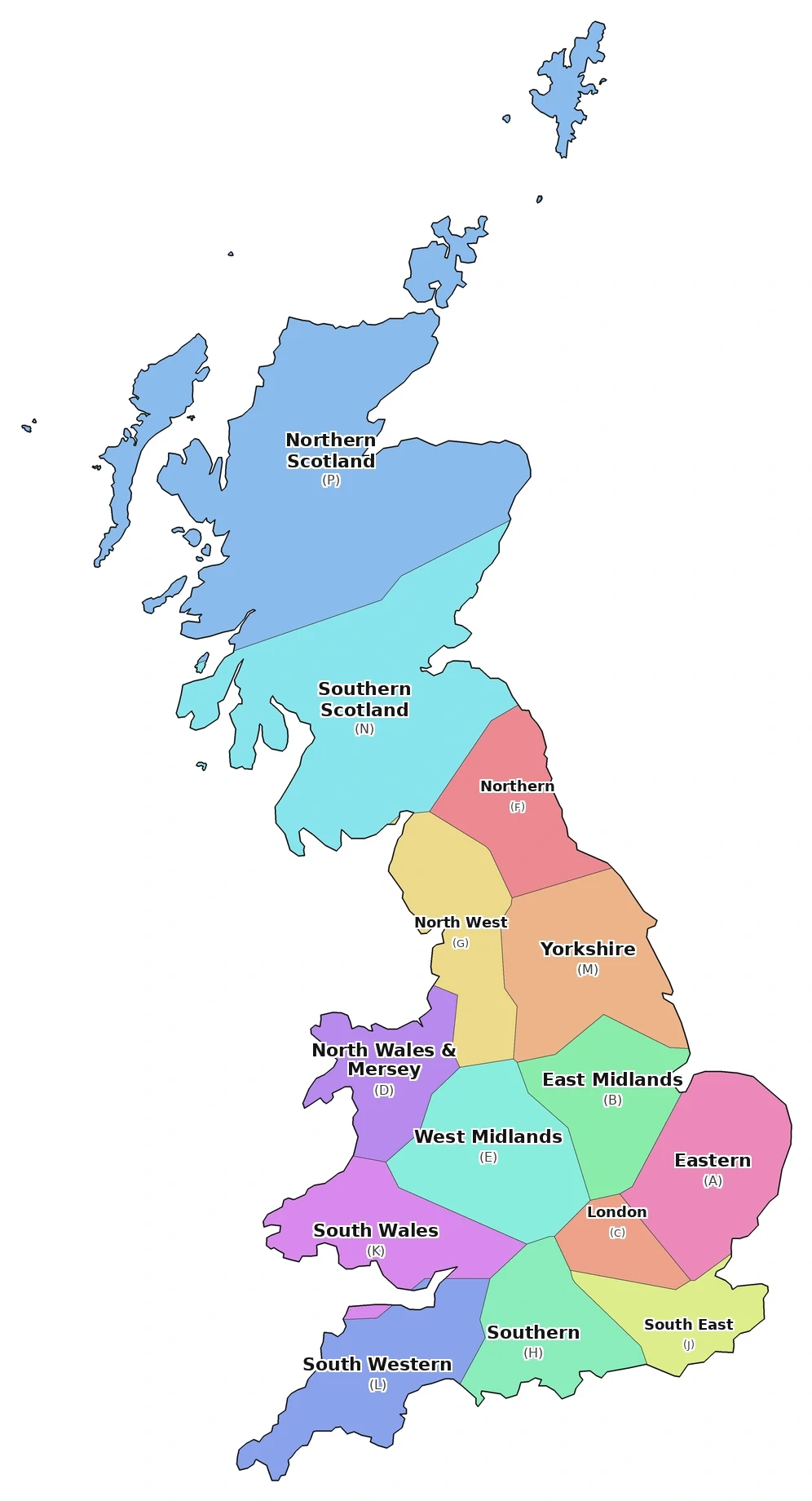
Each zone has its own locational TNUoS demand charge.
How is each demand zone’s tariff calculated?
NESO uses a transport model to estimate the cost of transmission to and from each of the 14 zones, based on typical network conditions.
Zones further from major sources of generation, or that place more strain on the network, such as those served by DNOs in areas with high electricity demand relative to local generation, tend to attract higher tariffs.
General zones North of the Midlands pay minimal locational charges, while zones further south pay the highest charges.
Read our guide on IDNOs.
How do TNUoS residual bands work?
The TNUoS residual charge (the component that represents the nationwide, site-specific usage of the national grid) is structured into residual price bands, each with its own £ per day rate.
Every site in Britain is assigned to a band, depending on whether the customer is domestic or non-domestic, its meter type, the supply voltage, and its consumption or capacity.
The bands work as follows:
Swipe the table horizontally to see all columns on a mobile device.
Source: NESO
Does the residual TNUoS band change over time?
A site’s band remains fixed for the duration of the current price control period, with the current period, RIIO-3, running from 2026/27 to 2030/31.
It only changes if the site’s Available Supply Capacity (ASC) is formally amended, or when bands are reset at the next price control review.
TNUoS charge calculation
A site’s total TNUoS fees are calculated as follows:
Total TNUoS demand charge (£) = locational demand charge (if applicable) + fixed residual charge
Here’s a simplified worked example for a half-hourly metered business, using illustrative rates to show how each part is calculated.
Calculating a fixed residual charge
This daily charge depends entirely on the customer type, meter type and supply type. The site is placed into a band depending on these, independent of its electricity consumption.
Say the customer is a hospital with an HV (High Voltage) supply, and has agreed a capacity of 1,000 kVA with its DNO. This puts the site in Band 2, which as of 2026/27 carries a rate of £117/day.
- £117/day × 365 days = £42,705 per year
The site pays this whether it uses a lot of electricity or a little, it’s fixed for the whole charging year.
Calculating the locational demand charge
This part depends on the site’s demand and which of the 14 zones it sits in.
For a site with a half-hourly meter, it’s based on the site’s demand (in kW) during peak periods, multiplied by its zone’s tariff (in £/kW).
Say the business has a peak demand of 500 kW and sits in a southern zone with a tariff of £45/kW.
- 500 kW × £7.35/kW = £3,675 per year
A business with the same demand in a northern zone, would pay nothing as there is no charge.
Calculating the total TNUoS charge
The total is simply the two parts added together:
- Fixed residual charge: £42,705
- Locational demand charge: £3,675
- Total TNUoS charge: £46,380 per year
How do TNUoS charges appear on business electricity bills?
How TNUoS appears on business electricity bills depends on the type of contract a business is on.
Fixed contracts
Typical customer: Smaller, lower-usage businesses.
On a fixed energy contract, TNUoS is built into the fixed standing charge.
This gives a business one all-in price for its electricity, and the TNUoS charge does not appear as a separate item on the bill.
Because these contracts are usually fixed for 1-3 years, the supplier has to forecast future TNUoS tariffs and add a risk premium to cover any increases.
Pass-through contracts
Typical customer: Larger premises with a half-hourly meter.
On a pass-through contract, TNUoS is presented separately from the wholesale energy cost.
The business pays the actual TNUoS charge as its own line item, alongside other non-commodity costs.
This gives more visibility over what is being paid and why, but it also means the TNUoS cost sits outside the fixed portion of the contract.
Can businesses reduce TNUoS charges?
Since the 2023 reforms changed the TNUoS charge into a fixed charge based on capacity band rather than usage, cutting electricity consumption no longer reduces the largest part of the bill.
The main levers now are:
- Review the agreed capacity (kVA): For half-hourly sites, the charge band is set by the Available Supply Capacity the business falls into. Many businesses hold more capacity than they need, so reducing it where appropriate can move a site into a lower band. Find out more on our Capacity Charge Analysis service page.
- Consider on-site generation or battery storage: Behind-the-meter systems let a site “peak shave” and, over time, reduce the capacity it needs, lowering its band. This is the longer-term, capital-intensive route.
- Reduce demand at peak times (locational charge only): This no longer affects the fixed residual charge, but can still trim the smaller locational element for half-hourly sites.
- Negotiating with the supplier: Suppliers typically add a margin into the standing charge to cover TNUoS costs, and that margin is negotiable. Compare rates with our business electricity comparison service to see if you’re overpaying.
What to check if your TNUoS charge looks wrong?
If a TNUoS charge appears higher than expected, the cause is usually an incorrect input. Check the following to identify the issue before it is raised formally:
- Agreed capacity (kVA): For half-hourly sites, the band is determined by Available Supply Capacity.
- Band allocation: Confirm that the site’s capacity or annual consumption corresponds to the band being charged. Sites close to a band boundary warrant particular attention, especially following the April 2026 threshold revisions, which moved some sites into a higher band.
- Connection voltage (LV, HV or EHV): An incorrectly recorded voltage tier results in the wrong set of bands and rates being applied.
Working through these checks can be time-consuming, and it’s easy to miss something. Talk to our energy experts today, they can review your bill, check your allocated banding, and help challenge any discrepancy with your supplier or network operator.
TNUoS charges FAQs
Our business electricity experts answer commonly asked questions regarding Transmission Network Use of System (TNUoS) charges:
Can two sites in the same TNUoS zone have different charges?
Yes, two sites in the same demand zone pay the same locational rate, but the residual portion of their TNUoS charge can differ significantly.
The residual charge depends on each site’s meter type, supply voltage and capacity band rather than its location, so two neighbouring premises can pay very different amounts.
Can a business have more than one TNUoS band across different sites?
Yes, TNUoS is applied per site, as identified by its MPAN, so each site a business operates is independently placed in its own residual band based on its own meter type, voltage and capacity.
What happens to TNUoS if a site’s capacity changes during the year?
A change to a site’s agreed capacity (Available Supply Capacity) can move it into a different band, but the change is only reflected for the new period.
TNUoS tariffs are set for a charging year running from 1 April to 31 March, so a mid-period capacity amendment takes effect at the start of the new period.
Categories: