
Distribution Use of System (DUoS) charges make up a significant slice of every business electricity bill, yet many businesses are completely unaware of them. This guide covers what DUoS charges are, who sets them, how they are calculated, and what a business can do to keep them in check.
What are DUoS charges?
DUoS (Distribution Use of System) charges are the fees paid by businesses (and homes) for using their local distribution network: the cables, substations and transformers that carry electricity from the national grid to their premises.
Businesses pay the DUoS charges to their business energy suppliers, who collect the charge as part of the electricity bill and then pass it on to the relevant regional Distribution Network Operator (DNO) that operates the local network.
DUoS charges typically make up approximately 15% of all business electricity prices.
Who sets DUoS charges?
DUoS charges are set by each individual DNO, reflecting the unique circumstances of the local grid, such as size, geography, and local demand.
DUoS charges are updated annually in April, allowing each operator to adjust their fees to cover infrastructure expansion, changes in regional power demand, and inflation.
Ofgem provides a methodology that each DNO uses to calculate its annual DUoS tariffs, covering every customer type. Changes to DUoS tariffs are announced 15 months in advance to allow suppliers to incorporate them into their pricing.
Why do businesses pay DUoS charges?
For a business to receive power, electricity needs to be generated, transmitted through the national grid, and then distributed across a regional low-voltage distribution network for the final stretch.
DUoS covers the cost of running the latter, which is why every connected business is charged.
DUoS charges fund the work DNOs carry out to keep electricity flowing reliably, including:
- Maintaining the cables: The underground and overhead lines that carry electricity across the region.
- Running and upgrading substations and transformers: The equipment that keeps supply stable and at the correct voltage.
- Repairing faults: Fixing damage and restoring power after outages.
- Expanding the network: Adding capacity to meet rising demand and connect new premises.
How do DUoS charges appear on business electricity bills?
DUoS appear bundled into the tariff or itemised depending on a business’s meter type and contract:
Bundled into the tariff
For most smaller businesses on standard fixed business energy contracts, DUoS is built into the unit rate per kWh and the daily standing charge rather than listed separately.
Itemised as a pass-through charge
Alternatively, businesses on pass-through or flexible business energy contracts will typically receive DUoS charges as separate items on their business electricity bill.
The supplier passes through the DUoS unit and standing charges set by the DNO for that customer’s specific supply point (MPAN).
How are DUoS charges calculated?
A business’s DUoS charge is made up of several components that express its use of the distribution network, such as the power consumed and the capacity of the connection.
Here is how each component that makes up the charge is calculated, and the type of businesses it applies to:
Unit charge
Applies to all businesses.
A rate applied to every kWh of electricity used, measured in pence per kWh. It varies by time of day, split into red, amber and green bands, with red covering peak periods and carrying the highest rate.
Standing charge
Applies to all businesses.
A fixed daily charge applied regardless of how much electricity is used. It covers the basic cost of keeping the business connected to the network.
The rate depends on the site’s connection type and is set individually by each regional distribution network operator.
Capacity charge
Applies to sites with half-hourly meters.
A daily charge based on the Maximum Import Capacity (MIC) a business has agreed with its DNO, measured in pence per kVA.
It is payable on the full agreed capacity whether or not the business uses all of it. This means a site that has reserved more capacity than it needs to pay for it on a daily basis.
Find out how to optimise capacity charges using our capacity charge analysis service.
Excess capacity charge
Applies mainly to large sites with half-hourly meters.
An additional charge applied when a business exceeds its agreed MIC. It acts as a penalty for placing more strain on the network than was planned and reserved for.
Reactive power charge
Applies mainly to large sites with half-hourly meters.
A surcharge applied when a business draws excessive reactive power, typically from equipment such as large motors and transformers when they turn on. It is charged only when reactive power exceeds the DNO’s threshold.
A site that regularly incurs this charge usually has a poor power factor. This can often be improved by installing power factor correction equipment, which reduces the reactive power drawn and the associated cost.
The different DUoS unit charge bands
The unit charge is split into time bands that reflect how much demand is on the network at different times of the day. They are designed to encourage businesses to shift usage to quieter periods and stabilise demand.
These bands are commonly referred to by a traffic light system.
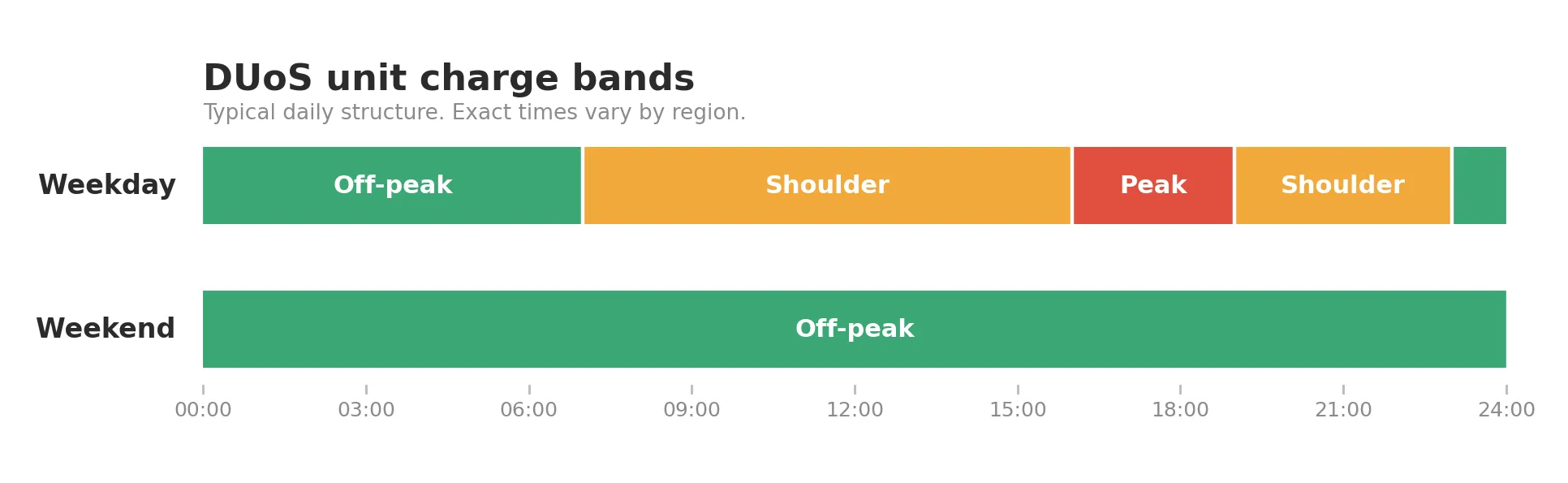
- Red: The peak power demand band, carrying the highest rate. It typically covers late afternoon and early evening on weekdays, when demand on the network is at its greatest. Usage during this window is far more expensive than at any other time.
- Amber: The shoulder band, set at a middle rate. It usually covers the rest of the weekday daytime, when demand is moderate.
- Green: The off-peak band, carrying the lowest rate. It generally covers overnight periods and weekends, when the network is least busy. Usage in this band can be very cheap by comparison.
The exact times for each band vary by region, as they are set by the local DNO to match demand patterns on that particular network.
The “super red” band for EHV sites
Some DNOs run a “super red” band for their largest consumers, known as Extra High Voltage (EHV) connections, that include major factories, data centres and some hospitals.
The band targets the point of greatest strain on the network, which falls on dark winter evenings when heating and lighting demand is at its highest.
For example, SP Energy Networks in southern Scotland currently run this band between 16:30 and 19:30 on winter weekdays, and does not apply it in summer.
Why do DUoS charges differ between businesses?
DUoS charges are designed so that each business pays according to how much strain it places on it on the local electricity distribution grid.
A business that draws more power, at lower voltages, or draws it at busier times, pays more.
This is how the characteristics of a business feed into its DUoS charge components:
Connection voltage
Businesses connect to the network at different voltages. Most, such as shops and offices, connect at low voltage (400V or 230V) at the bottom of the network, so their power passes through every stage of substations and transformers, and they pay higher rates.
Larger sites connect at high voltage (typically 11kV) or extra high voltage (33kV and above), nearer the top of the network, using less of it can pay lower unit rates.
Region
Each DNO sets its own rates for its region, each reflecting what it costs to run that particular network given the following factors:
- Network size, customer density and geography: A DNO covering a large, sparsely populated area, such as the Scottish Highlands, has far more cable and equipment to maintain per customer than a compact urban network, which pushes its rates up.
- Investment and upgrade needs: Regions modernising their infrastructure or connecting large amounts of new renewable generation carry higher costs while that work is under way, which feeds into their rates.
- Local demand patterns: How much power a region draws, and when, affects where network strain falls and how each DNO sets its time bands.
- Ofgem revenue allowances: Each DNO is permitted to recover a set level of revenue agreed with Ofgem, based on its own costs, and this allowance differs from region to region.
Electricity usage time
This drives the unit charge, as usage in the red peak band costs far more than the same usage overnight or at weekends.
Size of premises and capacity
Sites with half-hourly meters typically pay capacity charges that smaller businesses with lower demand for power do not pay.
Can businesses reduce DUoS Charges?
Both small and large businesses can reduce their DUoS charges by cutting its power consumption, generating or storing its own power, and shifting the remaining usage to off-peak and shoulder times.
Larger businesses can go further by estimating their capacity accurately to pay less each day, and by improving their power factor.
Here are the details:
- Shift usage away from the red band: Moving flexible activity, such as heavy machinery, charging or production runs, out of the weekday peak and into amber or green periods reduces the unit charge. Businesses can only benefit from this if they have a multi-rate energy tariff with their supplier.
- Consider on-site generation or storage: Solar panels or battery storage can lower the amount of power drawn from the network at peak times, reducing both unit and capacity-related charges.
- Right-size the agreed capacity (half-hourly only): Reviewing the Maximum Import Capacity (MIC) so it matches actual demand avoids paying for reserved capacity that is never used, while keeping enough headroom to avoid excess capacity charges.
Business energy suppliers typically add a margin on top of DUoS charges when designing tariffs for customers. Use our business electricity comparison service offered by our in-house experts to find a competitive new tariff for your organisation.
DUoS (Distribution Use of System) charges FAQs
Our businesses electricity experts answer commonly asked questions regarding DUoS charges:
Can my business energy supplier change my DUoS charges?
No. DUoS charges are set by your regional DNO under a methodology laid down by Ofgem, not by your supplier.
Do renewable electricity contracts still include DUoS charges?
Yes. Renewable electricity tariffs that use the grid incur the same DUoS charges as a standard electricity tariff.
The exception is private-wire Power Purchase Agreements that avoid distribution and transmission network charges.
Are DUoS charges subject to VAT?
Yes. DUoS forms part of the overall cost of the electricity supply, so it is subject to VAT at the same rate as the rest of the bill.
For most businesses this is the standard 20%, though some low-usage businesses and charities qualify for a reduced 5% rate. VAT-registered businesses can usually reclaim it as input tax.
Find out more in our guide to VAT on business energy bills.
Do export meters or on-site generation affect DUoS charges?
Export meters and on-site generation do not directly affect DUoS charges, as these only apply to electricity consumed from the public distribution network. Electricity exported back to the grid, as measured by an export meter, is not subject to import DUoS.
However, on-site generation can reduce DUoS charges indirectly, because power produced and used on site lowers the amount drawn from the network, which in turn reduces the unit and capacity-related charges.
Categories: