A DNO is the Distribution Network Operator in charge of a local electricity network that connects the national grid to residential and business customers.
This guide covers what a DNO does, how to find yours, the regions each one covers, and when a business needs to contact it.
What does DNO mean?
DNO stands for Distribution Network Operator, which is the company responsible for maintaining the local electricity network that carries power from the national transmission system (the national grid) to local homes and businesses within one of 14 DNO regions of Britain.
DNOs cannot be chosen by customers. Each operates within an appointed geographical area, so the DNO serving a property is determined entirely by its location. This contrasts with business energy suppliers that can serve customers in any location.
What does a Distribution Network Operator do?
A DNO is in charge of operating, maintaining, and developing the physical electricity infrastructure within its region. Here are its main responsibilities:
- Managing faults and power cuts: Repairing damage and restoring supply when outages occur, whether caused by severe weather, equipment failure, or accidental damage to cables.
- Maintaining infrastructure: Keeping substations, cables, and power lines in safe working order through regular inspections and planned upgrades, reducing the risk of unexpected faults.
- Connecting new supplies: Installing the infrastructure required to connect new homes and businesses to the network, such as laying new cables or upgrading a local substation to support a new development.
- Upgrading network capacity: Developing the network to meet growing or changing demand, for example reinforcing local infrastructure to support new housing developments or the rollout of electric vehicle charging points.
- Setting network charges: Charging for the use of the network via DUoS charges to fund maintenance and investment, with costs set by Ofgem and passed on through electricity bills rather than billed directly to customers.
Who is my DNO?
Every property or site in Britain has an assigned DNO based on its geographical location. There are three simple ways to find out who this is for any property:
- Check a recent business energy bill: The distributor is often listed alongside the supplier, usually near the top of the bill or within the account details section.
- Use a postcode lookup tool: The Energy Networks Association provides a postcode lookup tool, to confirm which DNO serves a specific address.
- Check the Distributor ID on the MPAN: The first two digits of the bottom line of the MPAN identify the DNO directly, and can be matched against the table in the section below.
DNO regions and areas
Britain is divided into 14 licensed distribution areas, each covering a fixed geographical region and served by a single DNO.
These boundaries date back to the area electricity boards created when the energy industry was nationalised in 1948. When the sector was privatised in 1990, the same regional boundaries were carried over and turned into licensed distribution areas overseen by Ofgem.
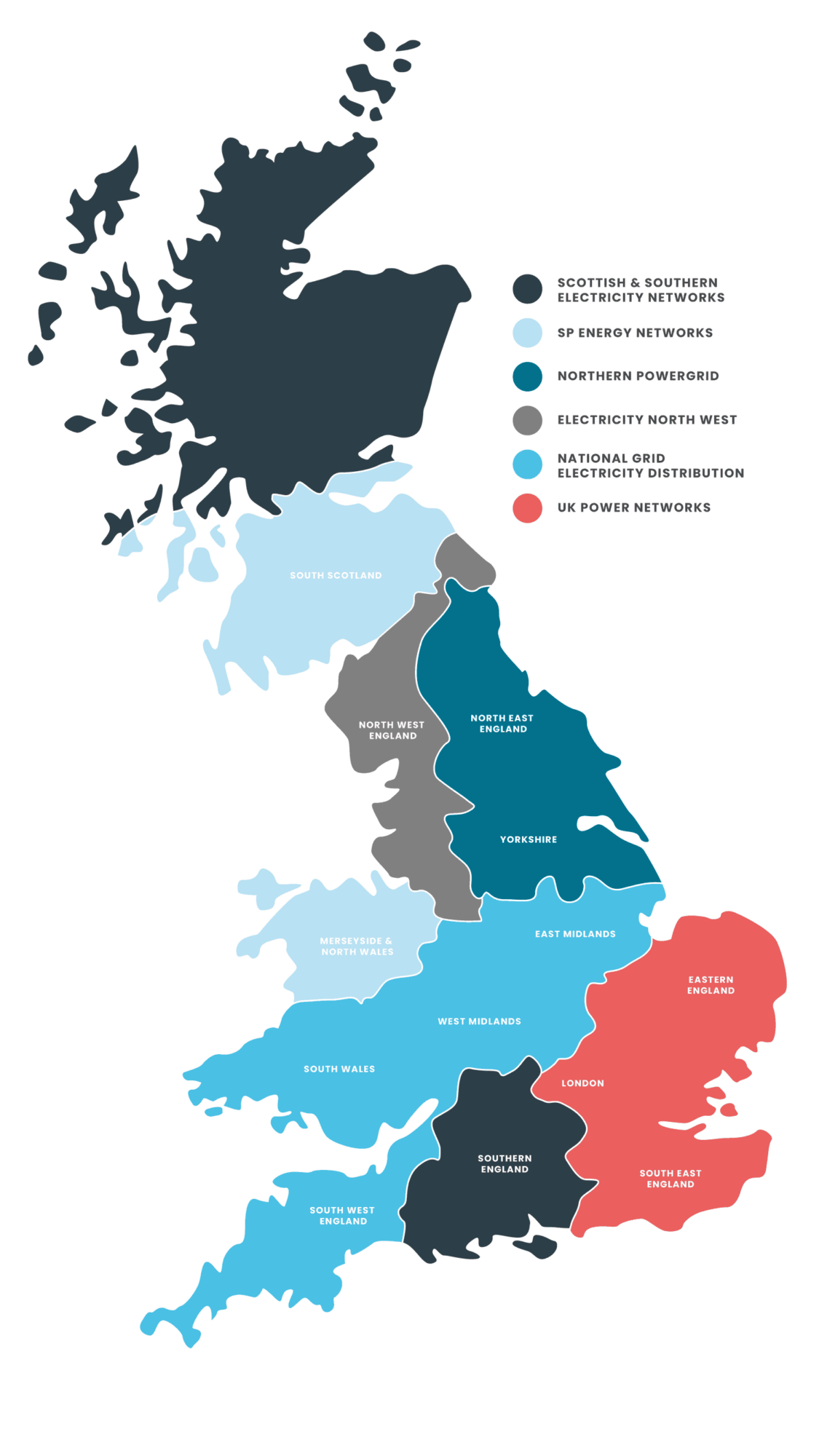
Through consolidation, six companies are now responsible for all 14 areas through their subsidiaries, each holding its own operating licence:
DNO map of Great Britain
The map below shows all 14 DNO licence areas across Britain, coloured by the company responsible for each one.
When would a business need to contact its DNO?
Most day-to-day contact regarding a site’s electricity supply goes through the business energy supplier, not the DNO. However, there are certain situations where a business needs to contact the DNO directly:
- Reporting a power cut: Flagging an unexpected loss of supply or checking for updates on a known outage in the area.
- Requesting a new connection: Arranging the infrastructure needed to connect a new site, unit, or development to the network.
- Increasing capacity: Upgrading an existing connection to support higher electricity demand, such as new machinery or EV charging points.
- Amending ASC: Changing the Available Supply Capacity of the connection with your DNO.
- Moving or altering a meter: Relocating a meter’s physical position, which requires the DNO to disconnect and reconnect the supply safely.
- Reporting damage to equipment: Flagging a damaged pole, cable, or substation, particularly if it presents a safety risk.
- Planning nearby building work: Checking clearance distances before construction, excavation, or tree work near overhead lines or underground cables.
Distribution network operator FAQs
Our business electricity experts answer commonly asked questions about DNOs in Great Britain.
Can a business change its DNO?
No, a DNO is assigned to every property in Britain. A business cannot switch to a different DNO the way it can compare business electricity suppliers and switch to more competitive business electricity prices.
The one exception is at the point of a new connection, where a business can choose to have the connection installed by an Independent Connection Provider (ICP) and, in some cases, adopted by an Independent Distribution Network Operator (IDNO) rather than the regional DNO.
This changes who owns and maintains that specific connection, but it doesn’t change which DNO operates the wider regional network.
Is a DNO responsible for my electricity meter?
No, the meter itself is owned and maintained by a meter operator appointed through the business energy supplier, not the DNO.
The DNO’s responsibility stops at the network infrastructure that carries electricity up to the property, including the cable and cut-out.
When there is an issue with the meter, the supplier is expected to resolve the issue, not the DNO.
Is a DNO the same as a DSO?
No, a DNO manages the physical electricity network, while a DSO (Distribution System Operator) is a broader, more active role that the same companies are gradually taking on, involving the real-time management of local generation, storage, and demand, such as solar panels, batteries, and EV charging feeding back into the network.
Every DNO in Britain is in the process of evolving toward DSO functions, so the two terms increasingly describe the same organisation at different stages of that transition.
Can a business have connections to more than one DNO?
Yes, in the case of businesses operating across multiple sites, since each site’s DNO is determined by its own location and different sites can fall into different regions.
It can also happen with a single large site, such as an industrial estate or business park, if it happens to straddle the boundary between two licensed distribution areas.
Categories: