Independent distribution network operators (IDNOs) are the competition to the incumbent distribution network operators (DNOs), which operate the regional electricity distribution networks in Great Britain.
This guide explains what IDNOs are and why they exist, how they operate and how they affect businesses, including their role in new connections, network ownership and charges for electricity consumers.
What is an IDNO?
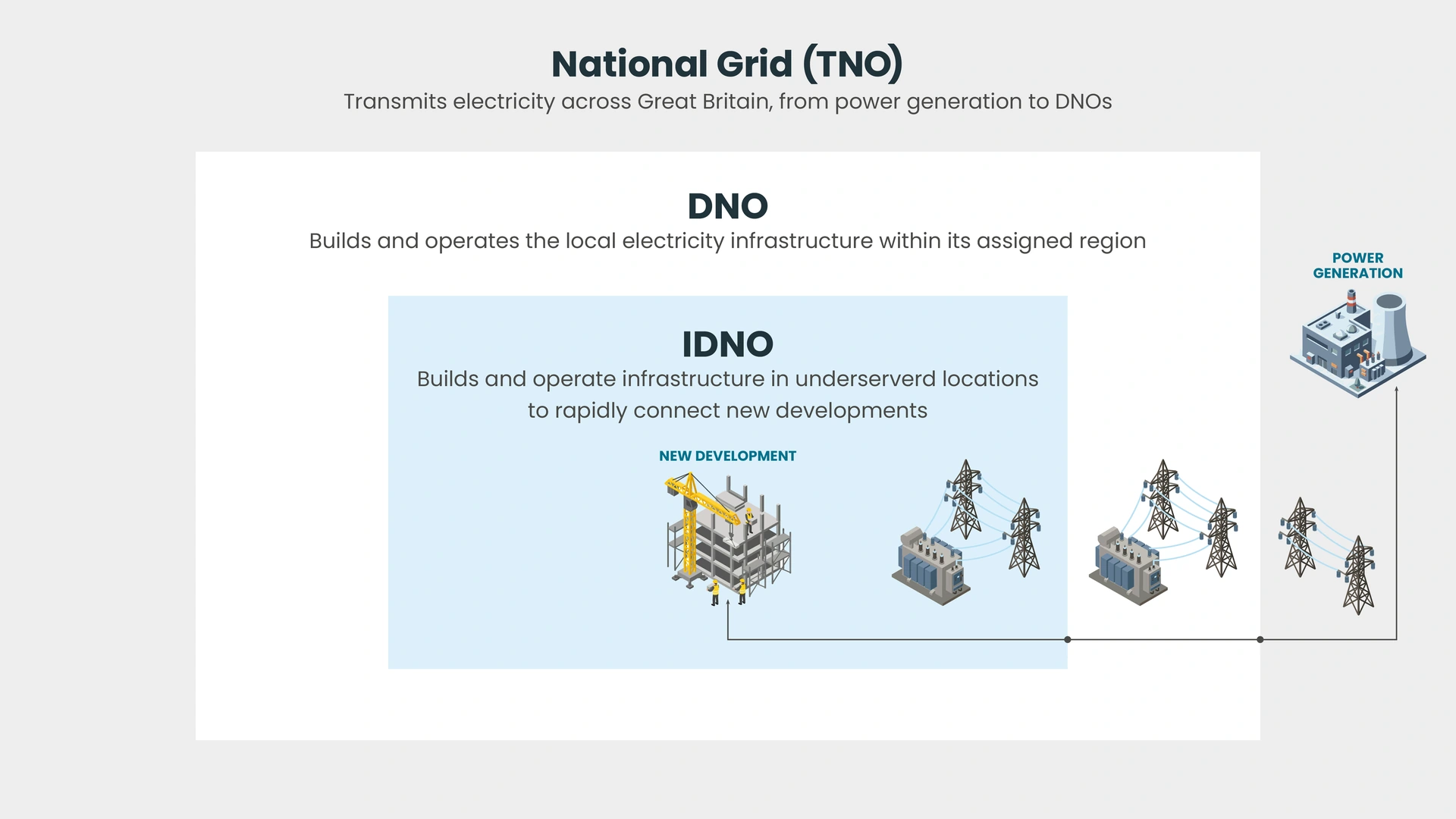
An Independent Distribution Network Operator (IDNO) is a licensed company that owns and operates electricity distribution networks in Great Britain, separate from the six incumbent regional Distribution Network Operators (DNOs).
IDNOs build and adopt the electricity infrastructure (underground cables, overhead lines, substations and transformers) on many new housing developments, industrial estates and commercial sites, then take on responsibility for the long-term operation of that sub-network.
IDNOs are not geographically bound and can build and adopt networks anywhere, including within regions already assigned to a DNO. This makes them direct competitors, especially for connecting new developments to the electricity grid.
IDNOs typically offer faster connection times and more flexible terms than the incumbents, who are busy serving their existing large customer base. IDNOs connect new premises by drawing electricity from the surrounding DNO’s network and distributing it directly to the development.
IDNOs operate within the same regulatory framework as DNOs, so the safety, reliability and connection standards are the same.
For a business, the practical difference is who to contact for connection or fault issues, rather than any change in the service itself.
How does an IDNO electricity network work?
An IDNO’s role covers several distinct functions, from securing new projects through to the long-term operation of the network it builds.
Here’s what this involves in practice:
1. Bidding for new connections
IDNOs compete with the local DNO and other IDNOs to secure the work of connecting a new development.
When a developer requests connection quotes, IDNOs submit proposals covering price, timescale and terms, and the developer selects whichever operator best suits the project.
2. Designing and building the network
Once appointed, the physical design and construction work is usually carried out by the IDNO itself, provided they have an ICP (independent connection provider) license.
This includes laying cables, installing substations and transformers, and building the network to the required technical standards.
3. Adopting and owning the infrastructure
Once construction is complete and the network meets Ofgem’s technical standards, the IDNO formally adopts it, taking on legal ownership.
From this point, the IDNO is responsible for that infrastructure indefinitely, rather than handing it back to the local DNO.
4. Distributing electricity to connected properties
The IDNO carries electricity from the boundary point with the DNO’s network through to individual properties on the site, functioning as the final stage of the distribution chain for that development.
5. Maintaining the network and managing faults
The IDNO is responsible for the ongoing maintenance of its network, including responding to faults and outages, independently of the surrounding DNO’s infrastructure.
6. Registering connections for billing
Each connected property is assigned an MPAN that identifies the IDNO as the responsible network operator. This allows electricity suppliers to bill customers correctly and pass network charges to the right operator.
7. Charging for use of the network
IDNOs generate revenue through Distribution Use of System (DUoS) charges, which are fees paid by electricity suppliers for using the IDNO’s network to deliver power to connected properties.
These charges are passed on to consumers as part of domestic and business electricity bills, and are regulated by Ofgem to ensure they remain broadly consistent with equivalent DNO charges.
Why are IDNOs used for new electricity connections?
Developers and businesses choose IDNOs over the incumbent DNO for several practical reasons, most of which come down to competition, flexibility and commercial terms:
- Faster connection times: IDNOs compete for work rather than holding a regional monopoly, so they normally have more capacity to prioritise a project and complete connections faster than a DNO working through its existing queue of regional projects.
- More flexible commercial terms: IDNOs can tailor contracts, payment structures and timescales to suit a specific development, whereas DNOs generally apply more standardised terms across all projects in their licensed area.
- Asset adoption payments: Many IDNOs pay developers an upfront sum, known as an Asset Adoption Value, in exchange for adopting the completed network. This offsets some of the construction cost and generates capital that DNOs typically do not offer in the same way.
- Tailored technical solutions: IDNOs can sometimes offer more bespoke network designs suited to a site’s specific requirements, particularly for developments with complex layouts or phased construction, rather than applying a one-size-fits-all regional approach.
- No impact on service quality: IDNOs operate under the same Ofgem licence conditions and performance standards as DNOs; businesses connected to an IDNO network receive an equivalent level of service and can still choose any business energy supplier on the market.
Typical developments that use IDNOs
IDNOs are most commonly used on projects where a new, self-contained electricity network needs to be built from scratch, such as:
- New housing developments: Large residential schemes where a new network is built to serve multiple properties.
- Industrial estates: Sites with several units requiring coordinated infrastructure and capacity planning.
- Business parks and commercial developments: Multi-occupancy sites where a single network serves several separate businesses.
- Mixed-use developments: Sites combining residential, commercial and retail units under one network.
- Renewable energy and generation sites: Solar farms, wind farms and battery storage sites that need a network connection to export power to the grid.
What is the difference between a DNO and an IDNO?
Both DNOs and IDNOs distribute electricity under Ofgem licences, but they differ in scope, ownership and how they’re appointed:
- Coverage: DNOs are assigned a fixed regional area, while IDNOs can operate networks anywhere in Great Britain.
- Appointment: DNOs are the default operator in their region, so IDNOs need to be specifically appointed by developers through competitive bidding.
- Network ownership: DNOs own the wider regional distribution network, while IDNOs own smaller sub-networks they’ve adopted on specific sites.
- Commercial terms: DNOs apply standardised terms across their region, while IDNOs can offer more flexible contracts and asset adoption payments.
- Market entry: DNOs are long-established incumbents, while IDNOs were introduced later to bring competition to the connections market.
List of IDNOs in the UK
There are currently 27 IDNOs licensed by Ofgem to own and operate electricity distribution networks in Great Britain.
Source: Ofgem
Some newer IDNOs have not yet had a distributor ID publicly confirmed, since this identifier is allocated through a separate industry system rather than published alongside Ofgem’s licensing register.
How do I find my IDNO?
There are three simple ways businesses can confirm which IDNO serves a given property, depending on what information is available:
- Check the electricity bill: The network operator’s name is usually listed alongside the supplier. This is the quickest way to confirm it directly if the bill is at hand.
- Look at the MPAN: The first two digits of the bottom line of an MPAN (also shown on the bill, and in other supplier documents) are the distributor ID, which can be matched against the current list of IDNOs to identify which one serves the property.
- Contact the supplier: Suppliers are required to know which network operator to route network charges to, so they can confirm this even without a bill to hand.
Who regulates IDNO companies?
Both IDNOs and DNOs are regulated by Ofgem. Ofgem grants each IDNO its electricity distribution licence, sets the conditions it must operate under, and can enforce action if those conditions aren’t met.
This keeps IDNOs accountable to the same regulatory standards as the wider distribution network, regardless of which company owns the physical infrastructure on a given site.
Does being connected to an IDNO affect business electricity prices?
Being connected to an IDNO network does not directly affect business electricity prices. Ofgem regulates the charges that apply to IDNO networks to ensure that customers do not pay more for distribution than they would for an equivalent connection to the regional DNO network.
IDNOs recover their costs through Distribution Use of System (DUoS) charges paid by energy suppliers, which operate within the relevant host DNO region.
Where a property is connected to an IDNO network, the supplier’s distribution payment is divided between the host DNO, which provides the upstream network, and the IDNO, which operates the local network.
The overall distribution charge is subject to Ofgem’s Relative Price Control, which limits IDNO charges to a level broadly consistent with the equivalent DNO charge for a comparable connection.
The rest of the electricity price is made up of other costs associated with supplying electricity, including wholesale electricity, transmission charges, environmental levies and supplier operating costs.
This has no bearing on which supplier a business can choose. It can compare business electricity quotes and choose the most competitive one.
Independent distribution network operators FAQs
Our business electricity experts answer commonly asked questions regarding IDNOs and their role in the electricity supply of businesses in Britain.
Can you change your IDNO?
No, if a premises is already connected to an IDNO network, the business cannot choose to change the network operator. The IDNO owns and operates the local network serving the premises, regardless of which electricity supplier the business uses.
The choice is only available when arranging a new electricity connection, when a business may be able to choose between an IDNO and the regional DNO.
What’s the difference between an IDNO and an electricity supplier?
An IDNO owns and operates the electricity distribution network serving the premises, while an electricity supplier sells the electricity and manages the supply contract and billing.
A business can therefore change its electricity supplier without changing the IDNO responsible for its local network.
What is IDNO asset adoption?
IDNO asset adoption is the process by which an IDNO takes legal ownership of a newly built electricity network.
Once the network has been constructed and meets the required technical standards, the IDNO adopts the infrastructure and becomes responsible for its ongoing operation and maintenance.
Does an IDNO own the electricity meter at a business premises?
No, the electricity meter is separate from the distribution network and is typically provided and managed under a metering arrangement through the supplier.
The IDNO owns and operates the underlying distribution infrastructure that delivers electricity to the premises, rather than the meter itself, which is handled by the supplier and a meter operator.
Can one commercial property have both DNO and IDNO connections?
Yes, a commercial property can have connections to different electricity distribution networks where it has separate connection points. Each connection has its own network operator and associated MPAN.
For example, a large commercial site may have an existing DNO connection serving the original building and a separate IDNO connection serving a new development or extension on the same site.
Can a business have multiple MPANs operated by different network operators?
Yes, this is typical of multi-site businesses, especially those whose premises sit across different regions. Each property has a separate MPAN, which can be served by a different DNO or IDNO.
What happens to an IDNO network if the IDNO company stops trading?
An IDNO network does not simply become disconnected if the IDNO company stops trading. As a licensed network operator, the IDNO has regulatory obligations relating to the operation and security of its network.
If ownership needs to be transferred, arrangements can be made for another licensed network operator to take responsibility for the network.
Categories: