
The MPAN is the unique identifier given to every electricity supply point in Great Britain, providing key information such as its location, network operator and registered supplier. This guide shows what an MPAN looks like and where to find it, then explains why it matters, how to use it, and the recent changes to its format.
What is an MPAN number?
MPAN stands for Meter Point Administration Number. It is the unique identifier of every electricity supply point across all properties in Great Britain, including homes, businesses and public buildings.
It gives industry stakeholders a consistent way to refer to a connection, regardless of which supplier happens to be responsible for it at the time, or the meter installed. This keeps billing, switching and metering matched to the right supply at all times.
An MPAN applies only to the mains electricity supply. Other utilities use their own equivalent systems, such as the MPRN for gas and the SPID for water.
What does an MPAN number look like?
The MPAN is 22 digits long, starts with a capital S for “Supply”, and is usually displayed split across two rows:
- The top row: Has 9 digits split into three sections that describe the supply’s key characteristics (Profile Class, SSC ID, DuoS Tariff ID).
- The bottom row: Has 13 digits split into another three sections that represent its unique address within the power network (Distributor ID, Unique ID, Check Digit). It is the number most suppliers and brokers mean when they talk about “the MPAN”.
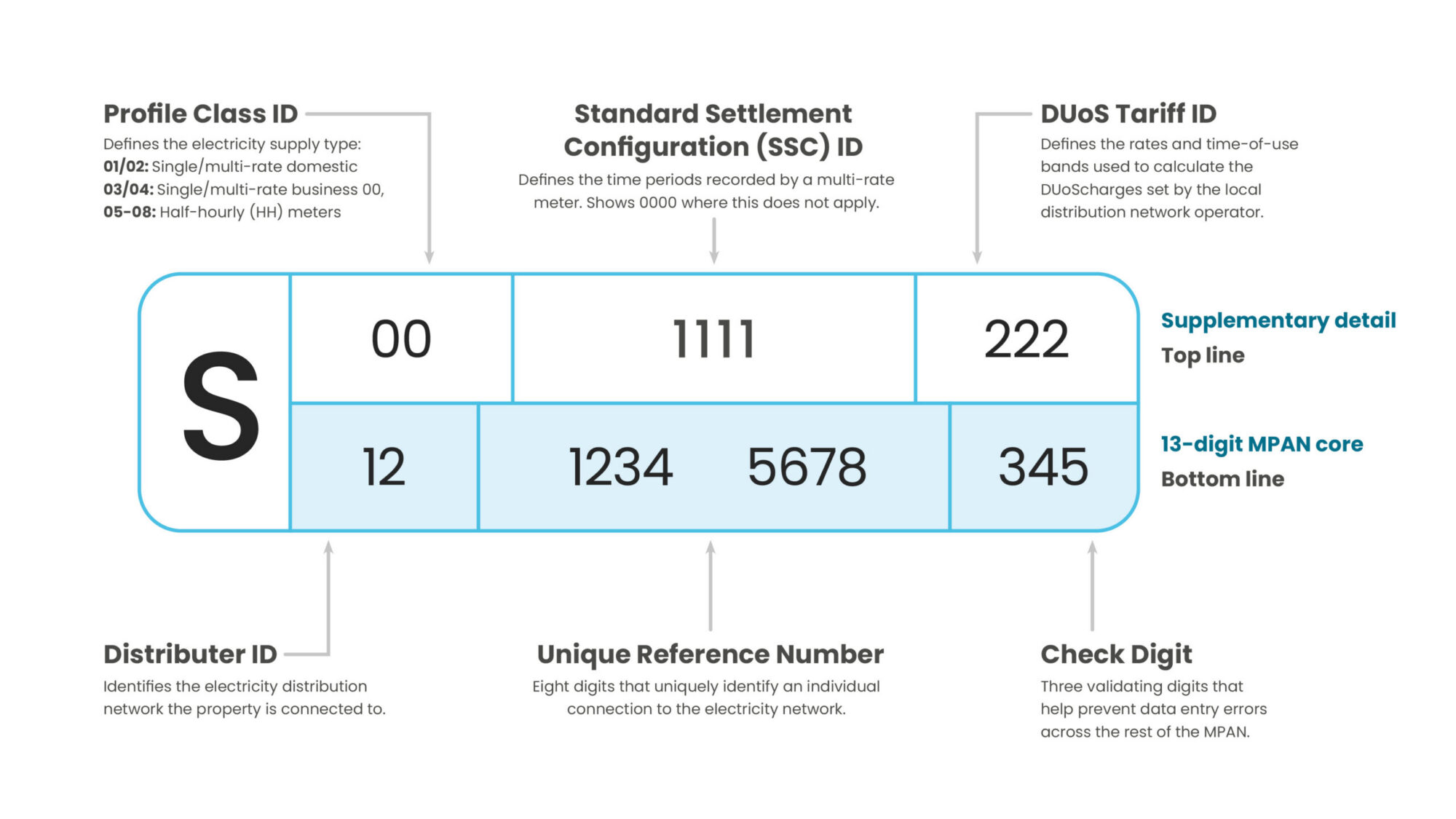
Here is what each section represents in more detail:
Profile Class (PC)
The first two digits of the top row
These describe the type of supply and the expected pattern of consumption, and the full set runs from 00 to 08:
For most businesses, Classes 03 and 04 cover standard small to medium sites, and Classes 05 to 08 and 00 relate to energy-intensive sites with half-hourly metering.
Standard Settlement Configuration ID (SSC)
The next four digits of the top row.
The SSC defines the set of time periods a meter records and how its registers map onto them, for example a single daytime rate or separate day and night registers.
It tells the industry how the meter’s readings should be broken down for settlement, and it shows 0000 where a single-rate arrangement means no configuration is needed.
This was previously the three-digit Meter Time Switch Code (MTC).
DUoS Tariff ID
The final three digits of the top row.
This identifies the distribution charging band that applies to the supply, meaning the rates and time-of-use periods the local network operator uses to calculate its Distribution Use of System (DUoS) charges.
These charges cover the cost of moving electricity across the regional distribution network and vary by site type and by time of day. This was previously the Line Loss Factor Class (LLFC).
Distributor ID
The first two digits of the bottom row.
These identify the distribution network operator (DNO) the supply point is connected to.
The Distributor ID is fixed to the property and does not change when a business switches supplier, because the DNO owns and maintains the local network regardless of who bills for the energy.
The digits go between 10 and 43+ and vary depending on the type of operator:
- Licensed regional DNO: Numbers between 10 and 23 are reserved for properties served by one of the fourteen licensed regional networks, such as Northern Powergrid in Yorkshire and UK Power Networks in London.
- IDNOs: Numbers from 24 upward belong to the growing number of independent distribution network operators expanding the network to serve sites such as new business parks. These operate alongside the regional DNOs, so they are not fixed to a geographic area.
Unique identifier
The next eight digits of the bottom row.
This is the reference the distributor issues to that specific supply point within its region. It is simply the unique identifier for every connection on the network.
Check digit
The final three digits of the bottom row.
This figure is calculated from the preceding twelve digits of the core using a fixed formula, so a mistyped MPAN will usually fail the check.
It exists to catch transcription errors before a switch or a quote is processed against the wrong supply.
What is an MPAN number used for?
An MPAN gives customers, suppliers, brokers and network operators of a specific supply the key necessary information to undertake most tasks. In day-to-day terms, a business needs its MPAN to:
- Obtain bespoke business electricity prices and switch suppliers: Suppliers and brokers use the MPAN to identify the exact supply being priced, so a quote and any subsequent contract are matched to the correct connection.
- Ensure accurate billing: The MPAN ties each bill to the right supply point, which keeps charges, meter readings and consumption data attributed to the correct premises.
- Register or transfer a supply: When a business moves in, takes over a lease or changes occupier, the MPAN is used to register the supply in its name and confirm responsibility for it.
- Arrange metering and connection work: Any meter exchange, new connection or upgrade is carried out against the MPAN, so the work is applied to the intended supply.
- Identify the network operator and report faults: The Distributor ID within the MPAN shows which DNO owns the local network, which is who a business contacts about power cuts, connections or supply issues.
- Manage multiple supplies: Where a site or portfolio has several grid connections, the MPAN distinguishes one connection from another and prevents the wrong meter being quoted or billed.
Where can I find my MPAN number?
Businesses can find their unique MPANs on most documents relating to their electricity supply, including an electricity bill, a supplier welcome pack, and the supplier’s website or app.
If these are unavailable, it can be obtained from the landlord, supplier, network operator, or an electricity broker, who can look it up from the supply address.
The one place it does not normally appear is on the commercial electricity meter itself, which typically shows the meter serial number instead.
Here is how the MPAN is usually displayed in each of these cases:
On the electricity bill
It sits in a box or grid marked with a large letter S, normally in a top or bottom corner of the first page.
It is often labelled “Supply Number”, “Meter Point Number” or “Electricity Supply Number” rather than “MPAN”.
In the online account or app
Most suppliers show it under the account, supply or meter details, frequently on the same screen as the meter serial number, tariff and consumption figures.
On supplier paperwork
It appears on the welcome pack sent when a supply is first set up, on the contract itself, and on renewal letters and annual statements.
From your landlord, supplier or network operator
When no paperwork is to hand, the MPAN can be traced from the supply address alone.
The current supplier will provide it once it has confirmed the caller’s identity, and the local distribution network operator (DNO) can supply both the MPAN and the registered supplier for any address.
A landlord, letting agent or previous occupier may also hold it, and a business energy broker acting on behalf of a business can obtain it too.
Can a property have more than one MPAN?
Yes. A single property can have more than one MPAN, most commonly in these situations:
- Multiple supplies: Larger premises sometimes have more than one incoming electricity connection, and each supply point carries its own MPAN.
- Multiple units in one building: In multi-occupancy premises, each unit or tenancy commonly has its own MPAN, and the communal or landlord’s supply for lifts, lighting and shared areas usually has a separate MPAN again.
What should you do if the MPAN details appear incorrect?
Problems with MPAN details are rare, but do happen occasionally. In most cases, it involves the MPAN, meter, or address being recorded incorrectly.
If there are any inconsistencies, contact your supplier to explain the discrepancy. The supplier, and where necessary the network operator, will investigate and can correct the records.
What are the changes to the MPAN top line?
The MPAN top line changed from 21 digits to 22 (not counting the leading S) on 22 September 2025, in an update sometimes called the supply number format change. Any bill, contract or annual statement produced from that date shows the new format.
The update is part of the Market-wide Half-Hourly Settlement (MHHS) programme, an industry-wide reform that moves every electricity meter onto half-hourly settlement.
The changes have little practical effect on businesses. Existing prices and agreements do not change, and the 13-digit MPAN core still identifies the supply, so quotes, switches and letters of authority all work exactly as before.
The top line changed, in two ways:
- The Meter Time Switch Code became the SSC: The three-digit Meter Time Switch Code (MTC) has been replaced by the four-digit Standard Settlement Configuration (SSC) ID, which shows 0000 where it does not apply.
- The Line Loss Factor Class became the DUoS Tariff ID: The Line Loss Factor Class (LLFC) has been renamed the DUoS Tariff ID, reflecting its role in the Distribution Use of System charges that fund the local network. Only the label changed, the numbers themselves stay the same.
MPAN FAQs
Our business energy experts answer commonly asked questions regarding the MPAN of non-domestic properties in Great Britain:
What do I need my MPAN for when arranging business electricity?
Strictly speaking, you do not need it to hand. Business energy suppliers and brokers can usually look up a supply point from the address and occupier details alone.
However, having the details handy is useful for verifying that a contract is being arranged for the correct supply point.
Can an inactive or disconnected electricity supply still have an MPAN?
Yes. An MPAN will remain against a supply point that is dormant or disconnected, which is why some premises carry MPANs that are not currently in use.
The supplier or the regional network operator can confirm the status of each one.
Can one MPAN be linked to more than one electricity meter?
Yes. A supply point normally has a single mains meter recorded against its MPAN, but additional meters, such as submeters, can also be associated with the same supply.
Whatever the arrangement, the MPAN still identifies a single connection with the grid.
Is an MPAN confidential information?
No. An MPAN identifies a supply point rather than a person, so it is shared routinely with suppliers and brokers when quoting or switching. Like any information though, it is still sensible to share it only with legitimate parties.
Will a new electricity connection receive a new MPAN?
Yes. When a distribution network operator sets up a brand-new supply point, it issues a new MPAN for it. That MPAN then stays with the supply from then on.
Categories: