
A business installs a new electricity meter when it upgrades to a smart or half-hourly meter, switches to three-phase power, or when the existing meter reaches the end of its life. This guide explains how a commercial electricity meter installation works, who carries it out, and what to have in place before booking one.
What are commercial electricity meters?
Commercial electricity meters measure the amount of electrical power, in kWh, consumed by business premises over a given period.
This includes both simple smart meters that relay readings back to suppliers, and advanced half-hourly meters built to handle commercial and industrial-scale supplies, including:
- Measuring reactive power consumption
- Measuring consumption for a three-phase power supply
- Taking automatic readings every 30 minutes
Every power supply feeding a property has its own meter. Larger premises sometimes add submeters to allocate costs internally, like rebilling tenants in a multi-let building or tracking consumption by department or equipment.
Electricity suppliers rely on the main meter to calculate electricity bills, with the individual power supply identifiable via an MPAN.
When does a business need an electricity meter installation?
There are multiple reasons a business installs a new electricity meter at their premises, including:
When the supplier offers to install a smart or half-hourly meter
Suppliers are actively arranging for their business customers to migrate onto smart meters, which record electricity consumption automatically and send readings remotely back to the supplier.
This is driven by the government’s smart metering mandate, which gives suppliers binding targets to roll metering out to their customers, in preparation for the market-wide half-hourly settlement reform.
As a result, suppliers are proactively approaching businesses to arrange these upgrades, typically at no cost to the customer.
Electricity demand has increased
Growing businesses that are adding machinery, EV chargers or floor space to their premises will experience growing electricity demand, which can outgrow the existing supply and meter:
- Outgrowing the supply: A higher load needs an upgraded connection from the DNO, and sometimes a move from single-phase to three-phase power.
- Outgrowing the meter: Passing certain thresholds, such as 100kVA, moves a site onto half-hourly metering.
An existing meter needs replacing
Meters have a fixed lifecycle and are replaced every 10 to 20 years, depending on the model, once their certification expires.
One may be swapped sooner if it develops a fault, or no longer meets industry standards.
The meter is being relocated
Occasionally a refurbishment or extension means an existing meter has to be moved. Because the business doesn’t own the meter, this is arranged through the supplier, who sends an engineer to re-fit it.
Who installs a commercial electricity meter?
A business electricity meter is typically installed by an accredited Meter Operator (MOP), which can be the electricity supplier itself or a third party.
The choice of MOP typically depends on the type of premises:
- Small site smart meters: The electricity supplier manages the entire process on the business’s behalf. It sends its own or a third-party MOP-accredited engineer, and incorporates the cost into the standing charge. From the business’s point of view, the supplier has simply sent someone to fit the meter.
- Large site half-hourly meters: The business has greater flexibility. It can rely on its supplier as Meter Operator, or appoint one independently under a separate contract, an option many larger organisations take to secure more competitive rates.
What do you need before arranging a commercial electricity meter installation?
Aside from a live mains connection and an electricity contract, the following is needed before arranging an installation:
- Estimate the site’s expected maximum demand: The maximum power the site draws at once, measured in kW. This sets whether it needs a standard, smart, or half-hourly meter, and whether the connection has to be single-phase or three-phase.
- Estimate the site’s expected annual consumption: Roughly how much electricity the site uses across a year in kWh, which helps the supplier match the meter to the property.
- Prepare the site for the installation: Ensure someone is present to let the engineer in, and the meter position is clear of obstructions on the day.
- Confirm you have authority over the supply: For rented premises, the landlord may need to be involved, since responsibility for the meter and supply can sit with them.
Read our detailed guide on a new business gas connection.
The commercial electricity meter installation process
While the details vary from site to site, a commercial meter installation broadly follows the same path.
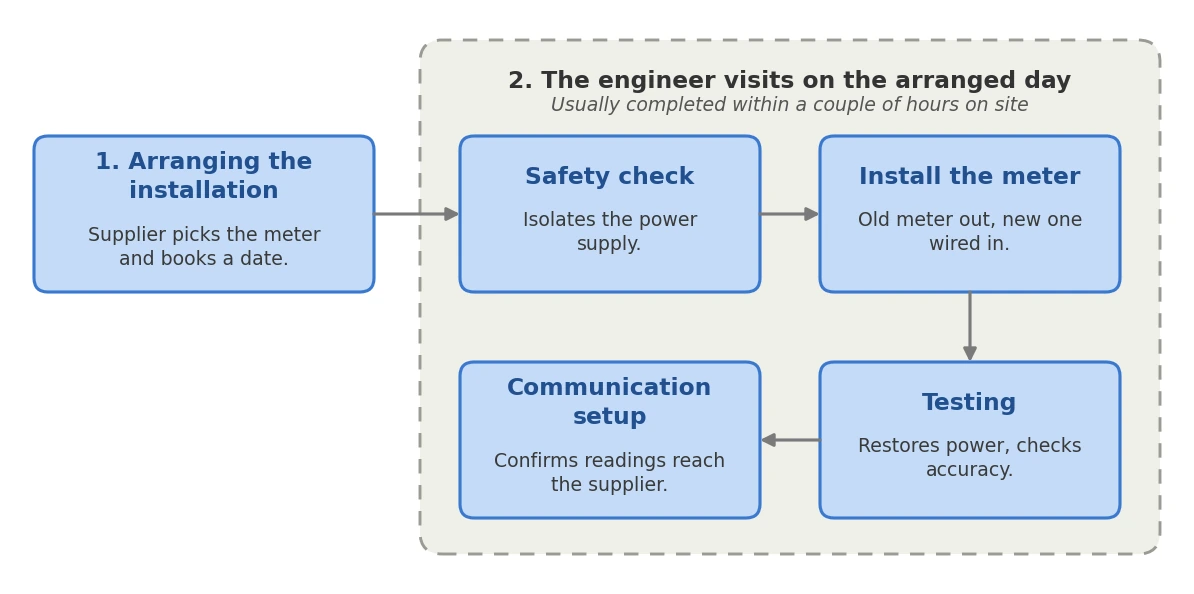
1. Arranging the installation
The supplier typically reaches out to the business to coordinate an installation, either by email or phone. The business provides the details needed to match the right meter to the site, such as the MPAN and expected demand, and agrees an installation date.
For a straightforward meter replacement or upgrade, this is a standalone appointment.
When the meter installation is part of wider electricity supply works (e.g. connecting a property to the grid or upgrading from single to three-phase power), it is coordinated directly between the DNO and supplier.
2. The engineer visits on the arranged day
The installation itself usually takes no more than a couple of hours from start to finish. It involves the following steps:
Safety check and power isolation
The engineer starts with a safety check of the existing electrical setup, then cuts the power supply so the work can be carried out safely.
Install the new meter
If an old meter is being replaced, it’s removed first. The new meter is then secured in position and wired in. On a single-phase supply, this is a straightforward like-for-like connection; on a three-phase supply the engineer needs to connect each phase separately.
Testing the meter
With the new meter fitted, the engineer restores power and runs tests to confirm it’s working correctly and safely. This includes a calibration check to make sure the meter is measuring the property’s consumption accurately.
Communication setup
As a final step, the engineer configures the meter’s communications module and checks its transmitting readings successfully back to the supplier via an internet connection.
What happens after the electricity meter is installed?
Once the smart or half-hourly meter is installed, there is very little manual intervention, with the following happening on an automatic or scheduled basis:
- Readings and billing: Readings are sent automatically to the electricity supplier to calculate their business electricity prices, with no manual reads needed.
- Maintenance and faults: The Meter Operator, usually contacted via the supplier, is responsible for maintaining the meter and fixing any faults.
- Lifespan and replacement: Each meter has a certified working life, typically 10 to 20 years depending on the model. Once that certification expires, the meter is either recertified or replaced.
Types of commercial electricity meter installation
The type of installation depends on the type of meter being installed. These are the most common:
- Single-phase meter: Used on smaller sites with lighter loads, such as retail units and offices. It’s the simplest fit, usually a like-for-like swap taking under an hour.
- Three-phase meter: Used on sites with heavier loads or three-phase equipment.
- Current-transformer (CT) meter: Used on high-load sites where the current is too high to pass directly through a standard meter. The current is measured indirectly through CT coils, which an electrician fits alongside the meter.
- Smart meters: Used by smaller businesses joining the national rollout, and by larger non-domestic sites. A standard fit plus a communications module that sends readings to the supplier automatically.
- Half-hourly (HH) meter: Required on sites over 100kVA, or any site being settled half-hourly. Needs a MOP appointment and is more complex to arrange and commission than a standard meter.
Commercial electricity meters in rented and multi-tenant premises
Metering gets more complicated when the business renting a property doesn’t own the supply. Since a meter can only be arranged through whoever holds the electricity contract, it’s worth confirming a few things before booking any work:
- Who holds the contract: In many tenancies the tenant holds it directly and can arrange meter work themselves. In others the landlord holds it and recharges energy through the rent, so any installation, upgrade or relocation has to go through them.
- How the building is supplied: Normally, each self-contained unit usually has its own supply and MPAN, so the business deals only with its own meter. However, some buildings run a single main supply with the landlord sub-metering each tenant, and there an individual tenant can’t arrange their own meter work at all.
- What the lease allows: Altering, upgrading or relocating a meter often needs landlord consent, so it’s worth checking before anything is booked.
Commercial electricity meter installation FAQs
Our business electricity experts answer commonly asked questions about installing a new meter at business premises.
Who owns a commercial electricity meter after installation?
The business never owns the meter. Ownership usually sits with a Meter Asset Provider (MAP), which owns the physical meter and leases it to the supplier. The Meter Operator (MOP), often the supplier itself, installs and maintains it.
Either way, the equipment is never the business’s own, and its upkeep is covered through the electricity bill.
Does a commercial electricity meter need its own isolator?
Larger and three-phase installations usually require an isolator switch fitted before the meter, allowing the supply to be safely cut for maintenance without involving the DNO.
Whether one is needed depends on the site, and the engineer confirms this at the assessment stage.
Can an import and export meter be installed at the same appointment?
Often yes. Properties with on-site energy generation and storage often use export metering alongside their import meter, and where the setup allows, both can be handled in a single visit. It’s worth flagging the export requirement when the work is arranged so the right meter is fitted.
Does a business need a new meter to switch electricity suppliers?
No. The meter stays in place, and the new supplier simply takes over the existing MPAN and reads it, so switching involves no installation or re-fitting. Compare business electricity suppliers to receive bespoke quotes from our panel of trusted business energy suppliers for your premises.
Categories: