

Business Gas Standing Charges
Your business standing charge is the fixed daily amount you pay for a gas supply, regardless of how much you use. We’ll explain what you’re paying and find you a competitive new contract.

What is a business gas standing charge?
A business gas standing charge is a fixed daily amount your supplier charges to keep mains gas supplied to your premises. It applies for every day you’re on supply, regardless of how much gas you use. It’s usually shown in pence per day on your business gas bill, separate from the unit rate you pay for each kWh of gas you use.
Because there’s no Ofgem price cap for businesses, standing charges aren’t regulated in the same way as household tariffs. Each supplier sets its own, and you agree to the rate as part of your contract. Standing charges are one reason business gas prices can vary so much between businesses of a similar size.
The total standing charge on a monthly bill is the daily standing charge multiplied by the number of days in the billing period. For example, a standing charge of 60p per day adds up to £18 for the month before you’ve used any gas at all.
What does a business gas standing charge cover?
Your standing charge pays for the fixed costs of supplying gas to your business, regardless of your usage. It is made of non-commodity costs, coming from the gas network and fixed costs from your supplier.
Here are the key underlying costs included within the business gas standing charge:
Network access
-
Part of your standing charge pays to keep your premises connected to the gas network. This covers the upkeep of the local pipes and infrastructure that make sure gas is there whenever you need it.
Gas transportation
-
Gas travels through the national transmission system and then local distribution networks before it reaches you. The network operators charge suppliers for this, and a share of that cost is passed on through your standing charge.
Metering
-
Your commercial gas meter has to be supplied, installed, maintained and read for each individual connection with the mains gas connection. Each supply point is identified by its own meter point reference number (MPRN).
Running your account
-
Suppliers have ongoing costs for managing your supply, including billing, account administration and customer support. These day-to-day operating costs are spread across customers through the standing charge.
Emergency and safety
-
The gas networks run a 24-hour emergency service to deal with leaks and safety issues. Funding for this round-the-clock cover is included in the network costs that feed into your standing charge.
Green Gas Levy
-
The Green Gas Lev funds a government scheme that supports green gas being added to the network. Suppliers pay it for every meter point they supply, so it’s usually passed on through your standing charge.

What is the average business gas standing charge?
Business gas standing charges depend on the capacity of your connection with the grid, where you’re based and the contract you’re on.
The figures below give a typical range for different sizes of business, based on published 2026/27 network charges.
The ranges are wide because each of our panel of business gas suppliers adds its own margin, and network costs vary by region. Large industrial sites can pay far more than the figures shown.
| Business size | Typical meter and usage | Daily standing charge | Annual cost | Why it varies |
|---|---|---|---|---|
| Small business | U6 meter, around 15,000 kWh a year | 35p to 75p | £130 to £275 | Network costs are similar to a household for micro business gas customers. |
| Medium business | U16 meter, around 50,000 kWh a year | 90p to £2.50 | £330 to £910 | Network costs rise with the capacity of your connection |
| Large business | U25 meter, around 100,000 kWh a year | £1.90 to £4.80 | £695 to £1,750 | Network costs rise with the capacity of your connection |
Why do business gas standing charges vary?
Two businesses can use a similar amount of gas and still pay very different standing charges.
That’s because the rate you pay depends on a mix of factors linked to your site, your supplier and your contract.
Your supplier
-
Each supplier sets its own standing charges and decides how to split costs between the daily charge and the unit rate. Some offer a lower standing charge with a higher unit rate, while others do the opposite.
Contract type
-
Fixed, variable and flexible energy contracts all price standing charges differently. Longer fixed terms often carry a slightly higher daily charge, as suppliers build in expected rises in network costs, while out-of-contract rates are usually the most expensive.
Annual Quantity
-
Your Annual Quantity (AQ) is the network’s estimate of how much gas your site uses in a year. It’s used to set the peak daily capacity the network must provide for you, and higher capacity means higher network costs in your standing charge.
Connection size
-
Larger meters and higher capacity connections cost more to provide and maintain. A bigger commercial gas connection or a site with several meters will usually pay more in fixed daily costs.
Network region
-
Gas is delivered by different regional network operators, and each sets its own distribution charges. Depending on where your premises are, the network element of your standing charge can be noticeably higher or lower.
New premises
-
If you move into a site without arranging a contract, you’ll be placed on deemed rates. These usually come with much higher standing charges, so it pays to agree to a contract as soon as you move in.
Why is my business gas standing charge so high?
If your standing charge looks higher than expected, there’s usually a clear reason behind it, and in many cases we can put it right. When you compare business gas with us, we look at the whole picture, not just your unit rate. Here are the most common causes and how we can help.
| Reason | What’s happening | How we can help |
|---|---|---|
| You’re out of contract | When a fixed contract ends without a new one in place, suppliers move you onto out-of-contract rates, which carry much higher standing charges. | We’ll find you a new fixed contract from our panel of suppliers and help you switch business energy to a more competitive contract. |
| You moved in without a contract | Businesses moving into new premises are placed on deemed rates until they agree a contract. | We’ll get a contract in place quickly and help arrange your change in tenancy, so you’re not paying deemed rates for longer than you need to. |
| Your usage is low | The standing charge is fixed, so it makes up a bigger share of your bill when you use little gas. | We’ll find a tariff that balances the standing charge and unit rate to suit how much gas you actually use. |
| Your supply is bigger than you need | If your capacity or Annual Quantity is set higher than your actual usage, you’ll pay more in network costs. | Our team will review your supply against your real usage and help you lower your capacity levels, so you’re not paying for more than you need. |
| You have meters you don’t use | Every active meter carries its own standing charge, even at empty or unused premises. | We’ll check every MPRN on your account and help you identify meters you no longer need. |
| Your rates have changed | On variable or pass-through contracts, rises in network costs or supplier pricing can be passed on to you. | We’ll explain your options, including fully fixed contracts that keep your standing charge the same for the whole term. |
| Your account details are wrong | Errors such as the wrong tariff, an incorrect AQ or charges for a meter that isn’t yours can push up your bill. | Our energy bureau service checks your bill against your contract and helps you raise any errors with your supplier. |
How business gas standing charges appear on your bill
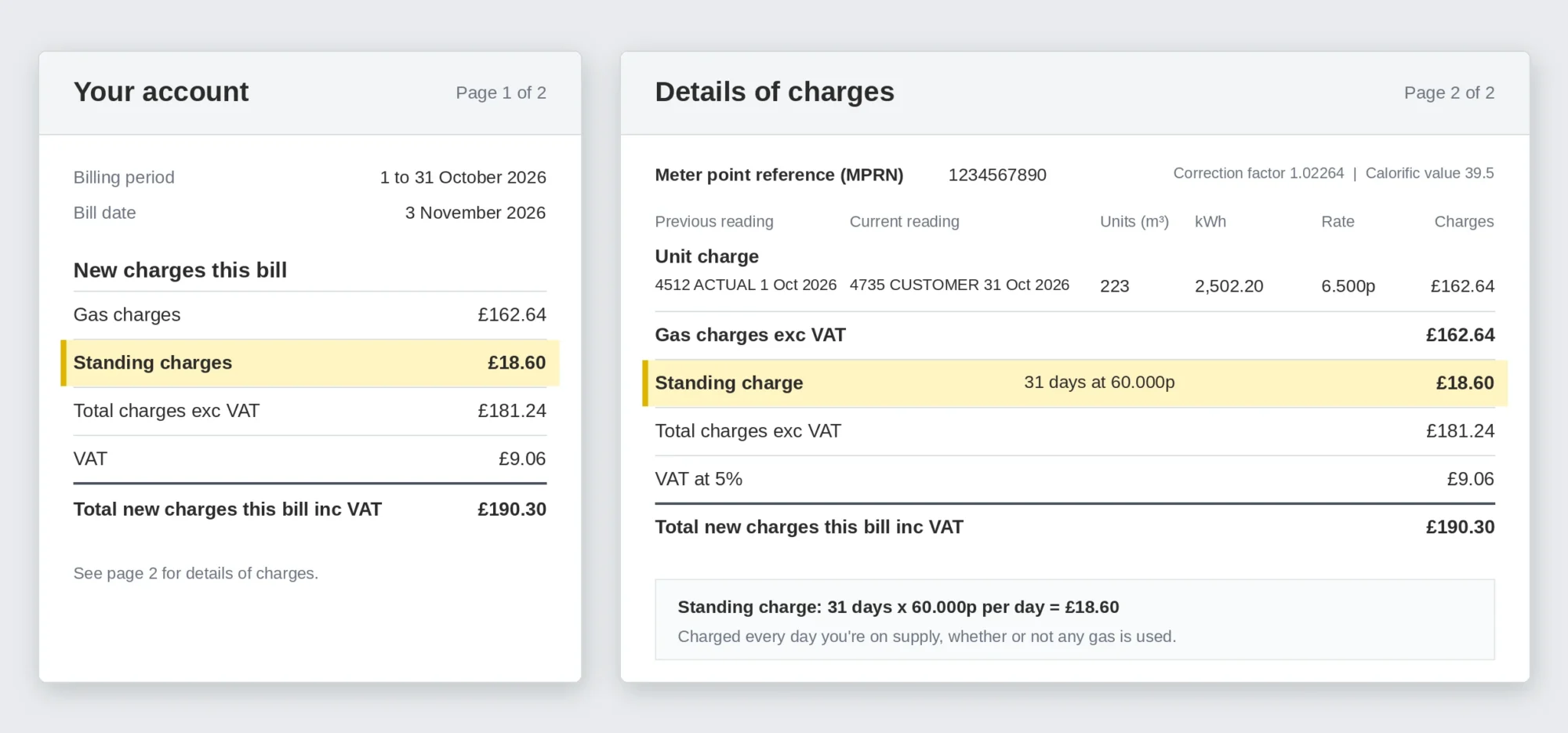
Your standing charge is listed separately from the gas you’ve used, so it’s easy to spot once you know where to look. It usually appears in two places on your bill.
On the summary page, it shows as its own line alongside your gas usage charge, giving the total standing charge for the billing period.
In the detailed breakdown, you’ll see how that total has been worked out, with your daily rate in pence multiplied by the number of days in the billing period. VAT is then added to the standing charge in the same way as the rest of your bill.
What affects your business gas standing charge
Standing charges are charged at the same daily rate during a fixed energy contract, but can change significantly on renewal. Here are the factors that affect business gas standing charges over time:
Network charge reviews
-
The gas networks update their charges every April, under price controls set by the regulator. These changes feed into the standing charges suppliers quote, so a renewal can look different even if nothing at your site has changed.
Fixed or pass-through
-
On a fully fixed contract, your standing charge stays the same for the whole term. On a pass-through contract, changes to network costs can be passed on to you, so your daily charge may rise partway through.
Time of your quote
-
Suppliers price standing charges based on their costs and the network charges in place at the time. Getting quotes well before your contract ends gives you more time to secure a rate before any changes take effect.
Peak daily demand
-
The network has to be ready to meet your highest daily usage, not just your average. Businesses that use a lot of gas on cold days, such as those with large heating systems, usually pay more for that capacity.
Smart meter rollout
-
Suppliers are required to offer smart meters to their customers, and they cover the cost of installing them and running the national smart meter network. These costs are usually spread across customers through standing charges, so they can add to your fixed daily costs whether or not you have a smart meter yet.
Multiple sites
-
Each supply point carries its own standing charge, so costs add up quickly across a portfolio. When you compare business energy across all your sites, aligned contracts make it easier to keep track of what you’re paying at each one.
What's the difference between a commercial gas standing charge and unit rate?
Your standing charge is a fixed daily amount you pay to stay connected and supplied, regardless of how much gas you use. Your unit rate is the price you pay for each kWh of gas you actually use, so that part of your bill goes up and down with your business energy consumption.
Both are agreed when you sign your contract, and suppliers balance them in different ways. A low standing charge often comes with a higher unit rate, and the other way round.
For businesses that use little gas, the standing charge makes up a bigger share of the bill, while higher users feel the unit rate more. That’s why we look at both together when finding you a contract.

Request business gas prices
Fill in the form and one of our energy experts will be in touch with a competitive quote based on your business’s individual needs. It only takes a minute, and there’s no obligation to switch.
Business gas standing charges FAQs
Do empty business premises pay gas standing charges?
Yes. As long as your premises are connected to the gas network, the standing charge still applies, even if the building is empty and no gas is used. If your business moves out, tell your supplier the date you’re leaving and give a final meter reading, so your responsibility ends from that date through a change of tenancy.
From then on, the landlord or owner usually pays the standing charge until a new occupier takes over. The only way to stop it completely is to have the supply disconnected and the meter removed or capped, which usually comes with a one-off cost.
Is there a business standing charge for every gas meter?
Yes. Each supply point has its own MPRN and its own standing charge, so a site with two meters will usually pay two standing charges.
In the Autumn Budget 2026, the government announced plans to remove gas standing charges from household bills from 2027, moving those costs onto the unit rate instead.
This change only covers homes, so businesses will still pay a standing charge for every gas meter. In some cases it’s possible to get a business gas tariff with no standing charge, but the unit rate will be higher to make up for it.
Can the business standing charge change during a fixed contract?
On a fully fixed contract, your standing charge stays the same for the whole term. On a pass-through contract, some network costs can be passed on to you, so your daily charge may change partway through. Always check which type you’re signing up to before you agree to a contract.
Is a zero standing charge business gas tariff cheaper?
Not usually. Zero standing charge tariffs are rare, and where they’re available, the fixed costs are added to the unit rate instead. They can suit very low users, but for most businesses they end up costing more overall. If you’re not sure which option suits you, contact us and our team will talk you through it.